Cyber5 Prep: Are You Ready for Paid Media’s Biggest Week?
how-to-guide
Cyber5 Prep: Are You Ready for Paid Media’s Biggest Week?
Cyber5 Influencer Marketing: A Deep Dive Into the Five-Day Paid Media Sprint
Every year the same pattern repeats. Teams spend October building a polished holiday campaign, then spend the first week of December explaining what went wrong. The gap between those two moments is Cyber5 — the compressed window running from Thanksgiving Day through Cyber Monday, when a disproportionate share of annual revenue gets decided in roughly 120 hours.
Cyber5 influencer marketing is not a scaled-up version of an always-on creator program. It's a different sport. Auction pressure multiplies, attention spans collapse, creator slots vanish early, and a decision made on Friday afternoon determines what is still possible on Monday. Treating this week as a sprint — with a starting gun, a pace plan, and a finish line — is the difference between a campaign that compounds and one that just spends.
The Cyber5 Calendar: Day-by-Day Intent Shifts

The single biggest mistake teams make is running one message across five days. Intent changes daily, and the creative, offers, and bidding posture should change with it.
| Day | Dominant intent | Best creative format | Bidding posture |
|---|---|---|---|
| Thanksgiving | Lean-back browsing | Native-feeling stories, gift guides | Low–moderate; build audiences |
| Black Friday | Deal hunting, comparison | Hard hooks, doorbuster offers | Aggressive on proven winners |
| Small Business Saturday | Discovery, values-led | Behind-the-scenes, founder-led | Moderate; niche targeting |
| Weekend | Research, save-for-later | Reviews, demos, comparison | Moderate; retargeting starts |
| Cyber Monday | Conversion, last chance | Urgency, bundles, shipping cutoffs | Highest; retargeting-weighted |
Thanksgiving is now a discovery day more than a shopping day. People are on their phones between conversations, scrolling without a defined purchase list. CPMs are typically softer than Friday and Monday, though that gap has narrowed as more brands push spend earlier. Use it to warm audiences and seed content that Friday and Monday will retarget.
Black Friday is where intent hardens. Creators need to lead with the offer, not the story — a two-second hook that names the discount, the product, and the urgency. On Cyber Monday, the audience has already seen your brand several times. Creative shifts from "here's something new" to "here's the deadline," and bidding shifts toward retargeting inventory where competition is intense but conversion probability is far higher.
Why Paid Media and KOL Spend Compress During Cyber5
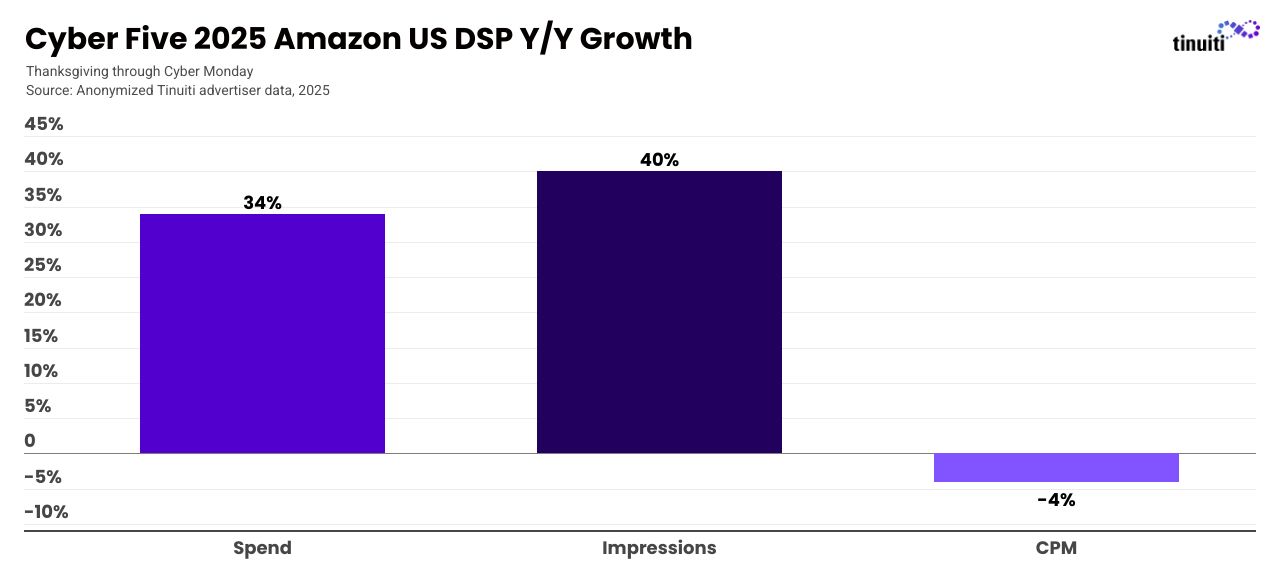
Three forces squeeze the same week simultaneously. First, auction pressure: nearly every advertiser in every category bids up the same inventory window, so CPMs climb while marginal returns fall. Second, attention fragmentation — users bounce between apps, tabs, and physical retail, so frequency needs to be higher just to register.
Third, and most underestimated, is coordination cost. Creator capacity is finite. The same few hundred high-performing creators receive dozens of Cyber5 pitches, which means contracts signed in late November expire before creative is approved. Teams that finalize roster decisions in October simply have better options.
There's also a hidden risk most dashboards won't surface: audience saturation. When five creators on your roster target the same 25–34 female segment in the same metro, you're not buying incremental reach — you're buying frequency against a group that already knows your offer. In practice, this shows up as falling engagement-to-click rates mid-week even though spend and impressions are climbing. Running an overlap check before launch, and capping posts per creator per platform, prevents it.
Key KPIs to Lock Before the Week Begins
You cannot optimize what you didn't define. Before spend escalates, agree on a single scorecard and freeze the definitions.
- ROAS (blended and creator-attributed): Track both. Creator-attributed ROAS will look better than blended, and the gap tells you how much value is being credited twice.
- CAC by acquisition channel: Blended CAC hides the fact that paid social usually gets more expensive while email and SMS get cheaper.
- Incremental lift: Holdout tests or geo splits. Last-click attribution cannot answer "would this sale have happened anyway?"
- Engagement-to-click rate: A creator-health metric, not a vanity metric. It falls first when fatigue sets in.
- Promo code redemption: Your cheapest attribution source, and the easiest to get wrong if codes aren't unique per creator.
- New customer acquisition rate: Growth teams care about this more than total revenue by Monday night.
Set thresholds as ranges tied to your own history rather than copying industry benchmarks, which vary enormously by vertical and margin structure. AI-powered matching tools such as KOL Find can benchmark creator-level performance against historical Cyber5 data, which is useful for ranking shortlists before a single contract is signed — just be careful not to let benchmarks override your own first-party results.
Readiness Audit: Are Your Campaign Assets Peak-Week Proof?

An audit two weeks out is worth ten dashboards during the week. Run it as a checklist with named owners.
Tracking, Attribution, and Promo Code Infrastructure
Verify UTMs, pixels, server-side events, affiliate links, and unique promo codes end to end — in a staging environment, not production. A naming convention prevents chaos later:
?utm_source=tiktok&utm_medium=paid_social&utm_campaign=cyber5_2026_tiktok_spark&utm_content=creator_042_hook_b&utm_term=doorbuster_bundle
Then confirm your server-side events dedupe cleanly against browser pixels, or you'll double-count conversions and misallocate budget all weekend:
// Share an event_id between the browser tag and the server payload
dataLayer.push({
  event: 'purchase',
  event_id: order.uuid,
  promo_code: order.discount_code,
  creator_id: attribution.creator_id,
  value: order.total
});
Test on mobile Safari and in-app browsers specifically. A large share of influencer traffic never touches a desktop browser, and truncated deep links are one of the most common silent failures of the week.
Budget, Bidding, and Inventory Scenarios
Build two budgets — a base case and a surge case — plus a floor you won't go below if conversion rates disappoint. Reserve budget for Cyber Monday instead of exhausting on Friday. Plan dayparting around your own historical hourly curves, and set flex caps so an automated bidding strategy can't drain a week of spend before Sunday.
Creative Volume and Approval Bottlenecks
Plan for roughly 3–5 creative variants per platform per creator for a serious Cyber5 push, more if you're testing hooks aggressively. Whitelisting and paid amplification requests, legal review, and usage rights take longer than anyone estimates in November. Submit the first batch three weeks out.
Common Gaps That Sink a Holiday Paid Media KOL Strategy
The recurring failures are predictable: contracts signed days before the campaign, missing usage rights that block paid amplification, no backup creators when two drop out, offer messaging that changes after creative is approved, and retargeting audiences built too late to accumulate volume. A lesson from past sprints: the teams that struggled weren't short on budget, they were short on approvals. Build a 72-hour approval SLA and hold it.
Building a Holiday Paid Media KOL Strategy That Fits Each Platform
TikTok: Fast Hooks, Spark Ads, and Trend-Jacking
TikTok rewards native-looking creative with a hook in the first two seconds. Spark Ads let you amplify creator posts through your own ad account while preserving organic social proof — usually the highest-performing format in the week. Approval is fast but unforgiving of anything polished to the point of looking like an ad.
Instagram: Reels, Stories, and Link Stickers
Sequence Reels for discovery and Stories for urgency. Link stickers convert well; combine them with a unique promo code so you can reconcile results later. Plan a narrative: tease midweek, launch Friday, remind on Sunday, close on Monday.
YouTube: Shorts, Long-Form Reviews, and Shopping Integrations
Shorts buy reach cheaply. Long-form reviews do the heavy consideration work and hold up longer after the week ends, which matters for January demand. Shopping integrations shorten the path to purchase, but they add production lead time — plan YouTube assets earliest.
Matching KOL Tiers to Funnel Stages
Macro creators build awareness and credibility; mid-tier creators drive consideration with demonstrations and comparisons; micro and nano creators convert through niche trust and specificity. A platform like KOL Find that analyzes millions of data points across TikTok, Instagram, and YouTube helps identify partners whose audiences sit at the right funnel stage rather than simply matching follower counts.
Black Friday Influencer Matching: From Shortlist to Signed Contract
Data Signals That Predict Black Friday Creator Performance
Weight signals that correlate with promotional response: audience overlap with your existing customers, engagement quality (comments versus likes), historical lift during past peak windows, brand safety, content velocity, and how audiences respond to discount messaging specifically.
How AI Matching Scores Creators Before the Rush
Manual shortlisting doesn't scale when you need 40 creators vetted in a week. AI-assisted matching ranks fit, forecasts likely performance, flags risk signals, and compresses days of spreadsheet work into hours. An AI-powered KOL matching platform such as KOL Find is most valuable here — before contracts are signed, when changes are still cheap.
Manual Vetting vs. AI-Assisted Matching: Pros and Cons
| Dimension | Manual vetting | AI-assisted matching |
|---|---|---|
| Speed | Slow, hard to scale | Fast, handles large pools |
| Nuance | Strong on tone and brand fit | Improving, still needs context |
| Risk detection | Depends on reviewer memory | Consistent, rule-based |
| Cost | High headcount hours | Predictable, low marginal cost |
The pragmatic answer is a hybrid: let the platform produce a ranked shortlist and risk flags, then have a human review the top tier for tone, controversy history, and offer fit.
Contracting Essentials
Lock exclusivity windows, paid amplification rights, whitelisting permissions, content approval deadlines, revision limits, and backup clauses. Contracts must be signed before peak week starts. Negotiating on Black Friday means paying a premium for worse creative.
Cyber Monday KOL Campaigns: Retargeting the Almost-Converted
Creative Angles for Cyber Monday KOL Campaigns
Lead with last-chance urgency, bundle savings, free shipping cutoffs, and social proof from the weekend's reviews. Avoid desperation: "final hours" works once, and repeating it three times in the same feed trains audiences to ignore you.
Retargeting Audiences Built During Black Friday
Build audiences from video viewers, engagement, cart abandoners, and site visitors starting Friday — not Monday morning. Platforms need a day or more to accumulate enough volume for delivery to stabilize.
Platform-Specific Retargeting with Creators
Spark Ads let you boost a creator's original post to viewers who watched but didn't convert. Instagram Reels ads can carry the same narrative forward. YouTube sequels that open with "if you were on the fence..." work well because they inherit the creator's credibility.
When to Shift Budget from Prospecting to Retargeting
Move budget when retargeting ROAS exceeds prospecting ROAS by a meaningful margin for two consecutive hours and CPA is trending below your target. Below that, keep feeding the top of the funnel. Daypart around evening peaks and pause during historically dead hours.
Creative and Offer Playbook for the Full Cyber5 Window
Offer Hierarchy
Rank offers by margin first, urgency second, creator fit third. Doorbusters create spikes but damage margin; bundles raise AOV; free shipping removes late-stage friction; payment incentives (pay-later, wallet discounts) convert consumers who are budget-constrained but intent-rich.
Creative Testing Cadence
Run a 72-hour sprint before launch to establish baseline hooks. During Cyber5, apply daily kill/scale rules: pause any variant with CPA above target after a statistically meaningful sample, scale winners in 20–30% increments. Rotate thumbnails and first frames every 48 hours.
Compliance, Disclosures, and Brand Safety
FTC endorsement guidance requires clear, conspicuous disclosure of material connections — "paid partnership" labels and verbal disclosures both count. Platform ad policies restrict certain claims and before/after imagery. Run brand safety checks on every creator's recent output, not just their profile description.
Hidden Insight: Creator Fatigue and Audience Saturation
Repeated posts from the same creator to the same audience cannibalize each other. Cap frequency, rotate creative, and check overlap between creator audiences before adding a sixth creator in the same niche.
Measurement and Live Optimization During Paid Media's Biggest Week
Attribution Models That Stand Up to Cyber5 Chaos
Last-click breaks during peak week because journeys span multiple creators and devices. Layer incrementality tests, geo holdouts, unique promo codes, and a marketing mix model to triangulate. Treat platform-reported ROAS as directional.
Daily Dashboard and Alerting Framework
Report by creator, platform, offer, and hour. Alert on CPA spikes above 25% of target, ROAS drops over two hours, and engagement-to-click decay that signals fatigue.
Kill/Scale Decision Rules
| Condition | Action |
|---|---|
| CPA > 125% of target after meaningful delivery | Pause or cut budget 50% |
| ROAS > 150% of target for 3+ hours | Scale in 20–30% increments |
| CTR down 30% with stable impressions | Refresh creative |
Using KOL Find Analytics to Adjust Mid-Flight
Mid-week data should inform next-week allocation. The platform's performance tracking lets teams reallocate spend toward creators whose audiences are converting and use that evidence to rebuild next year's shortlist with less guesswork.
Risk Management: What to Do When Peak Week Breaks
Creator dropouts: maintain a backup roster with pre-approved creative and rapid onboarding steps. Ad rejections and policy shifts: keep alternate formats ready and know which placements can be live within hours. Inventory and landing page failures: align paid media pauses with stockouts so you aren't paying to send traffic to a dead page. Budget triggers: define in advance who can move budget, by how much, and who escalates legal or platform issues. Ambiguity is expensive on a Monday.
Post-Cyber5 Wrap: Turning Peak-Week Data Into Next-Year Advantage
Follow up with non-converters using value messaging rather than another discount — endless promos train customers to wait. Document creator scorecards covering performance, content type, offer fit, and audience response while the week is fresh. Update your holiday paid media KOL strategy with those results, and keep historical Cyber5 data in KOL Find so next year's shortlist starts from evidence instead of memory.
Then extend the week's value: email and SMS flows, reusable UGC, referral offers, and loyalty pushes that turn a five-day sprint into a twelve-month relationship. That's how Cyber5 influencer marketing stops being an annual fire drill and starts compounding.